I watched the film about Husker football and a child's testicles so you don't have to
Going for Two is now showing in theaters across Nebraska.

Hi,
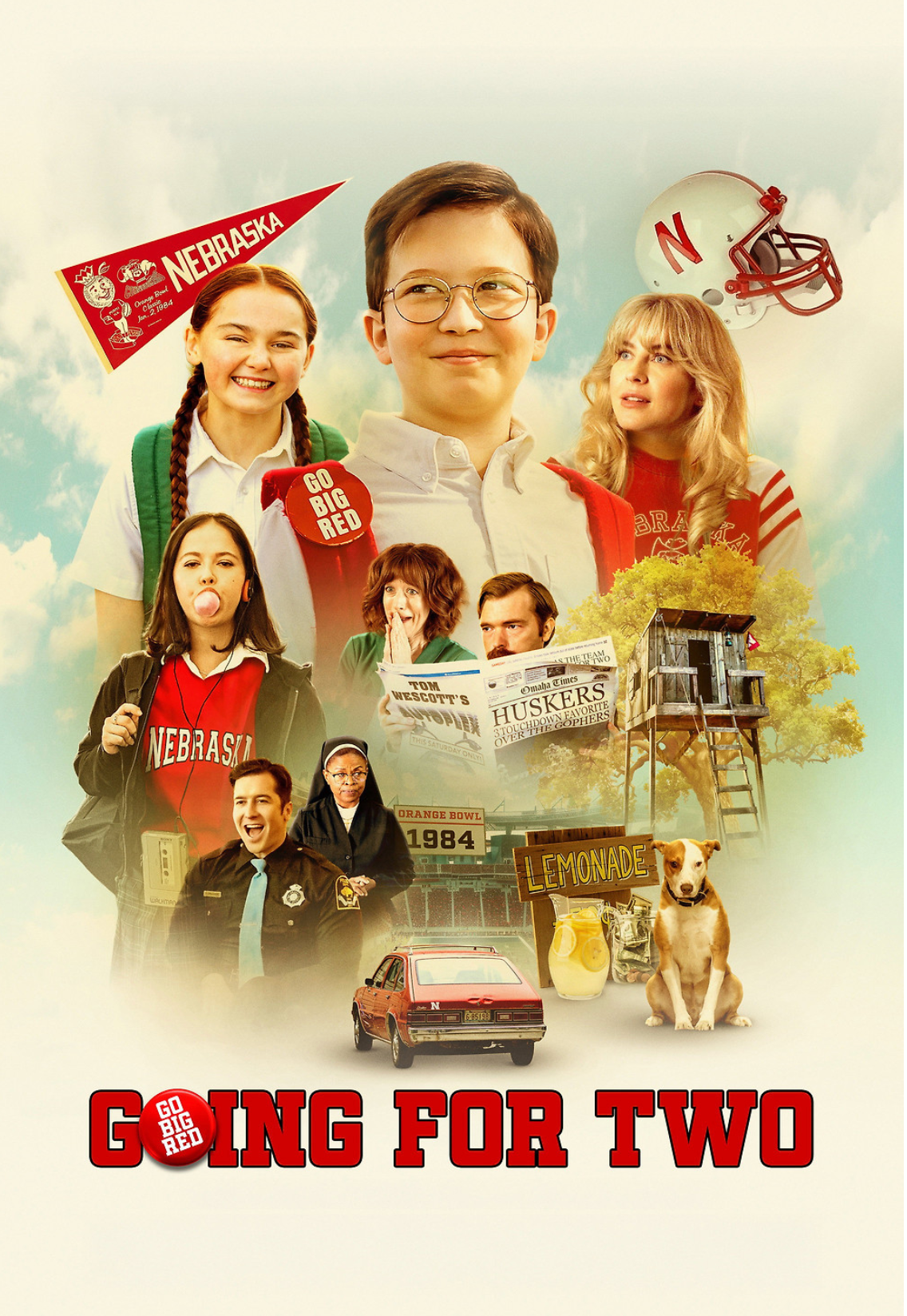
So I decided to go see the new Nebraska-centric film Going for Two yesterday. And I have some thoughts.
The writer-director is an Omaha native and the production took place in the city and, as a result, much of the local press around the movie has been laudatory and uplifting. I understand the impulse: Nebraska isn't really known as a film powerhouse (despite serving as the setting for quite a number of good and interesting productions) and every movie that makes it to screen is a miracle. Thus a new Nebraska-based production showing at local theaters is an easy feel-good story. (The fact that it's set during a legendary season of Husker football certainly helps too.)
While all of this is true, it doesn't change the fact that Going for Two is bad.
I always give you my honest thoughts about films I review for the newsletter and that's what I'm gonna do here. What happens in this movie is bonkers but it's being talked about in news coverage as a heartwarming coming-of-age story. I think you deserve the truth.
What follows is a lightly edited version of my stream-of-consciousness thoughts that I jotted down after seeing the film last night. I will be spoiling the entire thing.
The opening sequence is set in 1978 and it's either shot on old film stock (which would be kinda cool) or has some weird visual effect meant to signal that it's old (less cool). Then there's a hard cut: It's 1983 and suddenly it's being shot like any other movie in 2026. We go from what the director clearly thinks is a "vintage" style to a modern one but only five years have passed? A very strange choice.
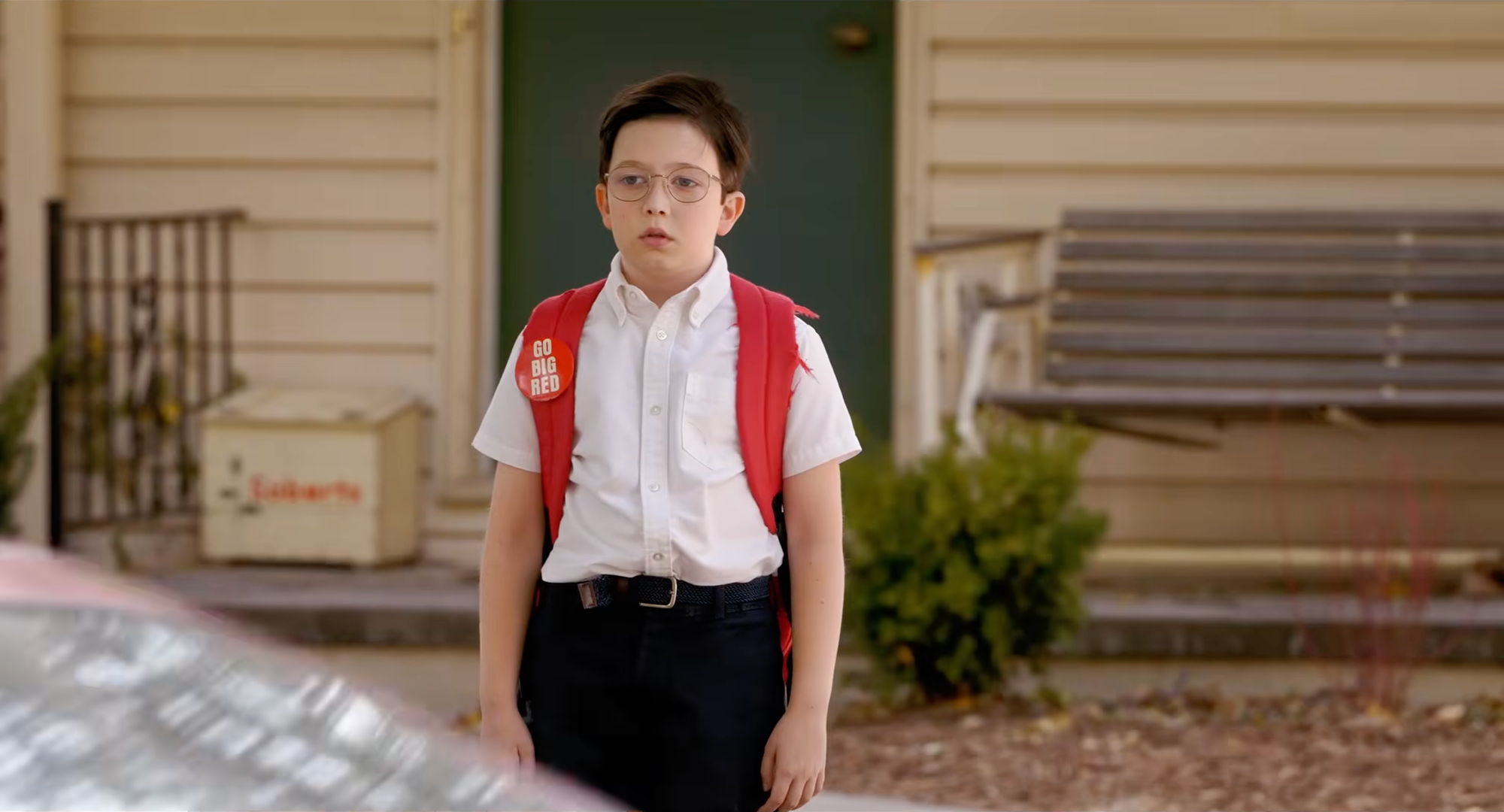
The first real glimpse of our protagonist Jimmy — i.e., Young Sheldon with glasses — is him getting out of bed and then looking conspicuously down the front of his pants. This is your first warning that this is a movie centered around a child's genitals. It is also your best chance to immediately bail. (I did not, alas.)
The twist here is that one of Jimmy's testicles has gone missing. He had two but he's now mysteriously down to one. Pretty sure this was included in the trailer but yeah that's what the "plot" of this movie will center on.
Jimmy doesn't have a dad — he died off screen during the time skip — so Jimmy's all like I don't have a father figure to talk to about this stuff. So he tells his best friend, a girl named Frankie, and she comes up with a plan: They're gonna investigate other boys' balls and figure out if Jimmy is normal or a freak.
How do they do this? Frankie decides Jimmy needs to go into the bathroom at their Catholic school and look at the other boys while they're peeing to see if they have two or just one. Jimmy doesn't want to do that (thank you, Jimmy) so Frankie is like haha okay I'll do it instead. She strides in there and sends the boys fleeing in terror.
This would be a bad scene regardless of when it was made. But in the current political climate, where conservatives are being psychotic and hysterical about trans children using their preferred bathrooms, it feels especially weird and tone deaf to play something like this for laughs. (To be clear it's not like the scene is explicitly about trans kids; it's just not a subject that feels particularly funny.)
Frankie's next great idea is to have Jimmy go look at magazines with naked men so he can check if they also have one testicle. So they roll up to a convenience store, she distracts the clerk, and Jimmy raids the magazine rack. I didn't get a good look at the magazine he grabs, but it's my understanding that most normal issues of men's health don't have full frontal so presumably he grabbed something pretty hardcore? Unclear.
While all this is happening there are like three concurrent subplots involving the rest of Jimmy's family. In one of these, his mom and his sister Molly have a conversation where mom is like honey, I need you to have the birds and bees talk with Jimmy because remember when I tried to have the talk with you and it went so poorly (?????). And Molly says what the fuck absolutely not.
But then Molly steals books on sexuality from the Willa Cather library and leaves them on Jimmy's nightstand.
Jimmy reads the books and decides he has cryptorchidism and starts to worry he'll get testicular cancer if it goes untreated. (A reasonable concern.) He and Frankie decide he needs surgery so they start brainstorming ways to raise money to pay for it. Their solution? Orchestrate a massive fraud scheme in which they say they are raising money for UNICEF but are actually collecting it to pay for Jimmy's medical treatment.
Their plot unravels only because the news media learns about it and their parents get a call from a TV producer who wants to feature Jimmy and Frankie handing the money to some guy from UNICEF — unclear why he's in Omaha — during the halftime show of the upcoming Huskers' game.
Notably, no adult ever catches on to the fact that Jimmy and Frankie were collecting the money under false pretenses. Ever. They go the entire movie without getting caught or fessing up. Now I don't expect movies to deliver simplistic moral lessons — in fact I usually prefer if they don't — but this movie is one of those that explicitly does try to deliver a simplistic moral lesson, mostly by idolizing Husker football coach Tom Osborne. Jimmy's ultimate epiphany in the film is that he needs to do the right thing "like coach would." But at no point does he recognize that hmm maybe lying to everyone about why I was raising money was in fact me NOT doing the right thing. The primary takeaway from the movie seems to be: As long as your money ends up going to a good cause, it doesn't matter if you obtained it through fraud. Heartwarming!
This dubious message is reinforced by the final dubious scheme that Jimmy and Frankie (and Molly, who is told off-screen about Jimmy's medical condition and agrees to help) dream up: Selling hot chocolate outside a Cheap Trick concert. But not just normal hot chocolate: They also decide to offer hot chocolate with peppermint schnapps!
They get caught, the cops kinda arrest them, and Molly lies to protect Jimmy by saying the money they were raising was for her to attend Juilliard because she wants to become an actor. (By the way this is the first time her supposed acting dream has come up in the film; there is no other reference to it that I recall.) To distract everyone, she jumps up on a bench and delivers the balcony soliloquy from Romeo and Juliet. Why this play? Why this speech? Who knows? I don't!
Anyway the kids get let off the hook because it turns out the cops had heard about them raising money for UNICEF and they assume their spiked hot chocolate stand was something similar. As long as they promise to donate the money to UNICEF, they'll get off with no charges. (This is in fact how the criminal justice system works.) Once again Jimmy and Frankie are morally validated for committing fraud.
The climax of the film takes place in the hospital (because Frankie's very Irish Catholic mom is giving birth to her fifth kid) during the 1983 national championship game. Here we are introduced to an entirely new child character, whose name is Max (I think). Max has cancer and a deadbeat dad who might have abandoned the family because of Max's cancer (though this isn't entirely clear). Jimmy and Max bond over their shared dearth of dads, and Jimmy realizes that, actually, he needs to do the right thing like coach Osborne would, which somehow translates to giving Max all the money the kids raised by selling spiked hot chocolate.
Oh yeah for reasons I do not understand, they just kept the money and didn't actually donate it like the cops told them to. Again the takeaway is crystal clear: It doesn't matter how you raise your money as long as it goes to a good cause in the end. (I wouldn't be hammering on this point so much if the film wasn't so heavy handed about its intended moralism: That coach Osborne is a saint who cared about his players and made ethically righteous play calls during games and that we should all act in a way that would make him proud.)
Finally, the main plot about Jimmy's testicles is resolved in a way that has no connection with any of the actual relationships in his life: He has a conversation with a random doctor in the hospital bathroom who tells him he probably has a retractile testicle, not an fully undescended one. Problem solved! And Jimmy didn't even have to form a real emotional connection with an adult in his life! He runs into the hospital room where his family and Frankie's family are gathered around the new baby, drops his pants and throws his hands in the air. Everyone gapes and gasps. Frankie also throws her hands in the air. His missing ball is presumably back. Credits roll.
A few other random points:
- There are the bones of a moderately interesting story here about a kid who learns to communicate with his mother about sensitive topics (like sex and his missing testicle). But for all the 'haha Jimmy has one ball' jokes, the movie is weirdly conservative and seems to view these kind of important heart-to-heart conversations as icky and embarrassing, at least when it comes to boys and their mothers. So they don't ever actually learn to communicate about such things. Plus the film has zero faith that Jimmy's mom can make it as a single parent and devotes a major subplot to her dogged attempts to rebuild the nuclear family unit. (More on that below.)
- At one point Frankie has an argument with her own mom in which she angrily tells her to "stop breeding." (Her very Catholic family has four kids and another on the way.) This was very funny.
- This scene is the only reason that the film might technically pass the Bechdel test. But not really? Getting through on a technicality in which the conversation is about having kids feels like a spiritual failure to me.
- All of the kids talk like they are teenagers from 2014. (One says "groaty" to refer to something gross.)
- Jimmy and Molly's dad died in a drunk driving accident (he was the one drunk driving) but the film also uses alcoholism as a punch line like five separate times, including once in a scene where Molly is literally drinking a beer while driving. I wouldn't care much about this except that the film wants to be both a comedy and a tearjerker about a family dealing with grief. But what it actually ends up being is tonally incoherent.
- Omaha, which had a population of over 300k in the 80s, is treated like it's a small town where everyone knows each other.
- There are two named characters of color, one of whom is used almost entirely as a plot device to dump exposition about the history of Husker football. Presumably this is because the filmmakers have deluded themselves into thinking this film will have marketability outside Nebraska and that national audiences will need this background knowledge about our state religion.
- This film was made by people who have no conception of what poverty looks like. Much is made over how Jimmy's family is struggling economically. His mom cries at one point about how they barely have enough money to buy groceries and we get a conspicuous shot of a bunch of "past due" envelopes piling up on the kitchen table. But it's all talk and no substance: At no point is the family distinguishable from every other upper middle class family in Omaha. Jimmy continues to go to a private Catholic school. There is no visible sign of hardship in their lives — no threat of eviction, no actual signs that anyone is going hungry, no moment when the electric company shuts off the power — and no part of their supposed economic precarity is ever seriously addressed or resolved by the end of the film. It's narrative poverty cosplay of the worst kind.
- There's a whole romantic subplot about the mom's dating life and her relationship with this local cop who has the hots for her. The film does the thing that every bad rom-com does: She rejects him but he pursues her anyway, stalks their neighborhood (haha so cute) and even kisses her moments after she very decisively rejects him, all of which is framed as normal behavior. So don't take no for an answer guys! Her rejections are just temporary roadblocks on the journey to your eventual romantic success! And this is in fact exactly what happens: They end up sharing a mutual kiss during the climactic Huskers game because why not. The real winner of the 1983 Orange Bowl? Toxic heterosexuality.
I'm so tired. Thanks for being here.
~ Ty
P.S. If you appreciate my writing, please consider signing up as a paid subscriber. I work as a freelance writer, so every new paid subscriber means I can spend a bit less time on other work and a bit more on making the newsletter better:
You can also support me on Patreon (and receive a complimentary paid subscription to the newsletter by doing so) or leave a one-time tip. A big thank-you to everyone who already contributes, you absolutely help to defray the costs of keeping this project going.