This new local music festival is giving the mic to queer musicians
An interview with the organizers of the first ever Queer Music Midwest Festival.
Hi,
When I put together my weekend event roundups each week, I'm often reminded that Lincoln is a fantastic music town. I've seen a lot of amazing shows in the year or so I've lived here, but I've had to skip many, many more. That feels like a pretty good indicator that our local scene is thriving. And if you need even more proof: There's a brand new music festival debuting this Saturday!
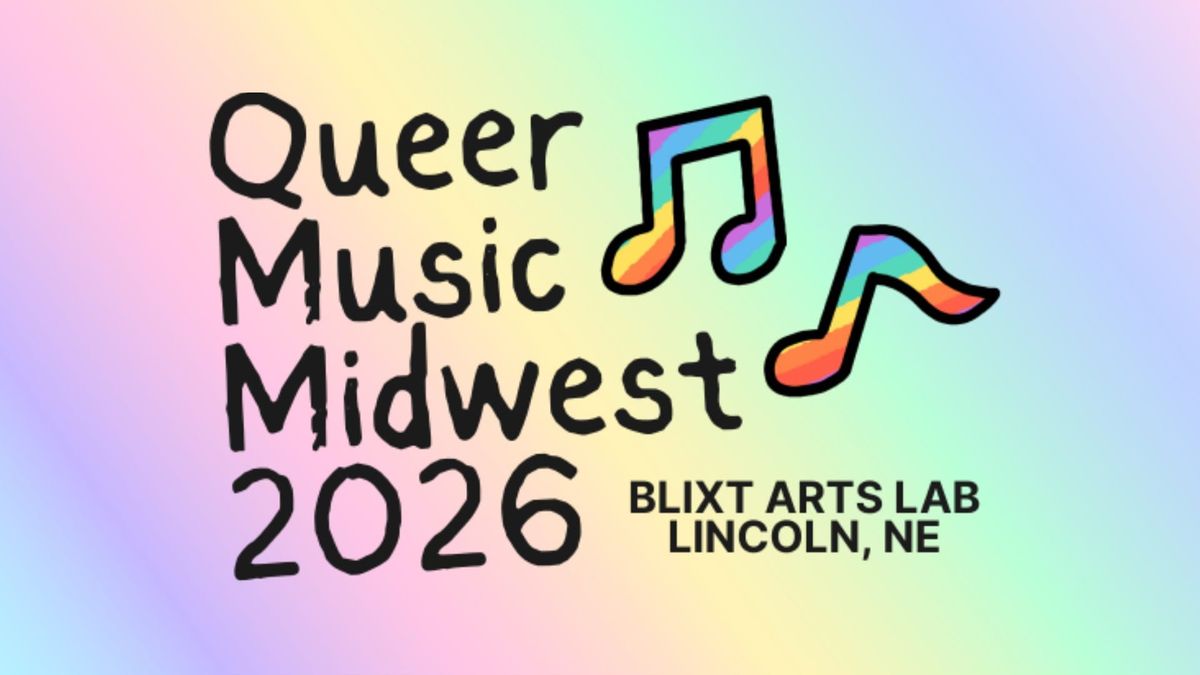
The Queer Music Midwest Festival is a one-day showcase that's devoted to platforming LGBTQ musicians here in the heartland.
+ When: 2 to 4 pm on Saturday, April 11
+ Where: BLIXT Arts Lab, 2626 N 48th St. (Google Maps)
+ Cost: Free!
Last week, I got a chance to talk with the festival organizers.
Joey Willette, Rose Khorsandi and Bridget Hill are graduates (or soon-to-be graduates) of the University of Nebraska-Lincoln, and together they're the founders of Queer Music Midwest, an organization dedicated to creating "a space for queer musicmakers to let their freak flags fly," as their website puts it.
They decided to create a new music festival, in part, because queer musicians in the Midwest don't always have chances to get their work heard.
"This is one way to champion the works of all of those folks who might not otherwise be featured or get a voice, and for all of us to have visibility and to see each other and to create a sense of community," Bridget told me.
The inaugural Queer Music Midwest Festival will showcase a few Lincoln acts, including singer-songwriter KJ Teder and folk duo (and members of the band Birthday Girl) The Clownfish and The Anemone.
There will also be a ton of flute music: Joshua Stine from Iowa (whose debut album is dropping soon!) will play a set, while Rose and Bridget will both perform music sourced from other queer composers who submitted their work to be played at the festival.
Finally, acid synth artist Winnifred, Worm Friend — who I believe is from Grand Island — will close out the show. (Winnifred not only writes awesome electronic bops; she also has a website with a sick early 2000s-esque design. Please check it out.)
You can find my full interview with Joey, Rose and Bridget below. I talked to them about why they founded Queer Music Midwest, what kind of feedback they've gotten since announcing the festival, and what goals they have for the future. Saturday is the organization's first official event, but they have other programming in the works, including a music salon for queer musicians being hosted by Sower Books in late May. (Applications are open until April 17.)
If you want to support Queer Music Midwest, you can donate to their GoFundMe or buy some merch! You can also follow the project on Instagram.
~ Ty
This interview has been edited for length and clarity.
Can y'all introduce yourselves, and talk about how you met and why you decided to start Queer Music Midwest?
Joey: I've given myself the title of director, but that's mainly because I've had the free time to do these initial projects. But really the three of us are all co-founders.
We all know each other through UNL. Rose and I have graduated from UNL, and Bridget is almost there. (She's about to finish her dissertation.) I graduated with my doctorate of musical arts in music composition just this past May.
Both Rose and Bridget have performed a lot of my music, and my music frequently centers queer identity and culture. When they performed for my lecture recital when I graduated, we were just getting together after rehearsals and having really long talks about what it meant to be queer and perform queer music in this part of the country. We just had this mutual interest in serving the queer community and providing spaces not only for folks here in Lincoln, but also hopefully beyond that.
Rose: Joey had this idea to do this in a way that's structured and organized. And it's been really, really cool to see how many people have been interested and invested and reached out to us.
I'm not from the Midwest. I moved here four years ago for school, and it was definitely a bit of a culture shock for me. It felt kind of isolating. And I think it has been really, really, really nice to connect with other people and build more of a sense of community that I definitely didn't feel before.
Bridget: I'm from the Midwest, from Iowa. So I've lived here my whole life and definitely echo Rose's sentiment on the culture part of it. Not always the easiest place to be LGBT, although that can be anywhere in the country at the moment.
There's so many queer musicians, queer composers that don't always have a means to be connected and to know about each other's work. So this is one way to champion the works of all of those folks who might not otherwise be featured or get a voice, and for all of us to have visibility and to see each other and to create a sense of community.
My work is all about that. My dissertation is a list of LGBT composers who've written music for flute, and that didn't exist as a resource. As far as I know, that doesn't exist for any other voice part or instrument.
Part of the reason for doing that is the visibility part — to say, “No, we are as diverse as every spectrum of color on the LGBT rainbow and have a breadth of expertise and experience and compositional styles that is really rich and diverse and robust and worth hearing about.”
Can you tell me more about the upcoming festival? How do you describe it to folks who are hearing about it for the first time?
Joey: I've been referring to it as Nebraska's first ever music festival solely for queer musicians. It is — as far as I can tell — the first time in history that there's been an event that centers specifically queer music and queer musicians in Nebraska.
It encompasses so many styles and genres and people from the Midwest. I'm trying to position it as a sort of cabaret of what the Midwest has to offer in terms of musicianship, in terms of musical artistry.
When Bridget was talking, it had me thinking about how a lot of the anti-queer rhetoric that people — especially politicians — tend to push relies really heavily on an us-versus-them mentality. I see events like the Queer Music Midwest Festival — and another event that we have coming up in May, the Lincoln Music Salon — as showing the public that we live here with you, we're doing the same things, and we have the same goals.
We all live in the same community, and we all just want to make our world better.
Which musicians are you most excited about?
Bridget: We put out a call for scores — for composers to submit works that they would like to have performed by our available musicians, which for the moment has been flute dominant, so that's what we got.
There's sometimes this perception of the Midwest: That this is not necessarily where you look for interesting, innovative, creative things, which is dead wrong. So it's really cool to see all these folks, either from the Midwest or with ties to the Midwest, that are creating interesting, creative, cool things. I'm looking forward to getting to play some of that.
Joey: Winnifred, Worm Friend is someone that I'm particularly interested in meeting. I think her music is some of the most quintessentially queer things that you can do. A trans woman doing electronic modular synthesis. It’s crazy, and it shows that the Midwest is a reflection of the greater United States.
KJ Teder is someone that I came to know through UNL. Very early on in the planning process of this, I was like, “I have to get her involved, I have to have her performing.” I think that she's just a really soulful musician and her songwriting is so impactful.
The Clownfish and the Anemone mentioned that they're going to do a couple of covers. So it's not entirely new music, but it's also things where they've taken it and they've shaped it into their own style, and I'm really excited about that.
We have Josh Stein. He's a professor of music in Iowa. The music he plays really centers the queer experience, and he talks about both exploring tragedy but also the joy of queerness and how that finds its way into the music he plays.
And then both Rose and Bridget are playing music from the call for scores that we did. We had over a dozen people apply to have their music performed. And I wish we could have chosen them all. But it just goes to show that there is a need for this, and people see that and want to be part of it.
The festival is free, correct?
Joey: Yeah, it's really important that events like these are accessible. I want as much as possible for Queer Music Midwest to do things that are free and open to the public.
But that does mean that we've had to find funding because I also want to make sure that these performers are being compensated for their labor. They're all getting paid, including Rose and Bridget, for their labor of learning this music and putting on the performances.
Do you have plans to make it an annual event?
Joey: I think we'd really love to. It became clear pretty early on after launching the organization that this has legs. There are people who are outside of Lincoln who are invested in this.
I did notice the name is Queer Music Midwest, not Nebraska. So do you have plans of expanding beyond the state?
Joey: We have connections in places like Ohio, a place where they just banned wearing clothing of other genders; places like Michigan, where it's a little more open and they're a little more friendly towards queer people. But we definitely are trying hard to make this happen in other places in the Midwest, to bring the Queer Music Midwest experience to those different places.
Bridget: Another component of the programming that we are aspiring to have is livestream options. Because for queer folks that might come from rural communities, their internet access is their connection to queer life. So livestreaming events under the umbrella of Queer Music Midwest, but all over the Midwest, so that we can watch a concert of queer music in Indiana or wherever it might happen.
Earlier, Rose mentioned the reception has been really positive since you announced the festival. Can you talk more about that?
Joey: I get DMs to the Queer Music Midwest social media pages saying, “This is so cool. How can I be part of it? What can I do to help the organization from where I live?”
Many of these folks may not live in the Midwest, but they really connect with the mission here. A lot of these folks are saying, “I want to write music. I want to perform music by queer composers. I want you to come to my city and highlight musicians in my city.”
Rose: I am a social media person against my own desires, but I've been posting quite a bit on my own social media and getting a lot of the same feedback. I had a conversation with someone this morning over Instagram DMs who I've never met, who I connected with through this project, and we're playing one of the pieces that he wrote. I'm really excited about it, and he's really excited that it's going to get played.
Anything else you want folks to know?
Joey: I don't think that this would have happened if I didn't know that there were other members of our community here who wanted to make it happen.
One of the biggest catalysts for this was when I went to BLIXT Arts Lab. They had this community meet and mingle day. And I made these connections with folks and they were saying things like, “We want this to be a space for the community as well. We want this to be more than just us putting on events.” That was what really triggered me wanting to do all of this.
Bridget: Also, you don't have to be queer to come to this! All allies are welcome, all folks who are interested.